iNTERCEPT – How A Small RF Experiment Turned Into A Community SIGINT Platform

I’ve always been fascinated by RF.
There’s something about the fact that it’s invisible, the fact that you might be able to hear aircraft passing overhead broadcasting their location, the fact that you might be able to pick out a ship a few miles out broadcasting their AIS information, the fact that you might occasionally hear a burst of random pager traffic or Bluetooth data floating through the air, that just makes you want to dig in and learn more.
Of course, the difficulty is that digging in and learning more can quickly descend into a chaotic mess.
One tool for ADS-B, another for AIS, another for pagers, another for WiFi, and so on. Some of them run in a terminal window, some of them run in a web interface, and some of them don’t even bother with documentation. It’s a lot of juggling and switching between windows, and it’s a lot of work.
That’s where iNTERCEPT came from.
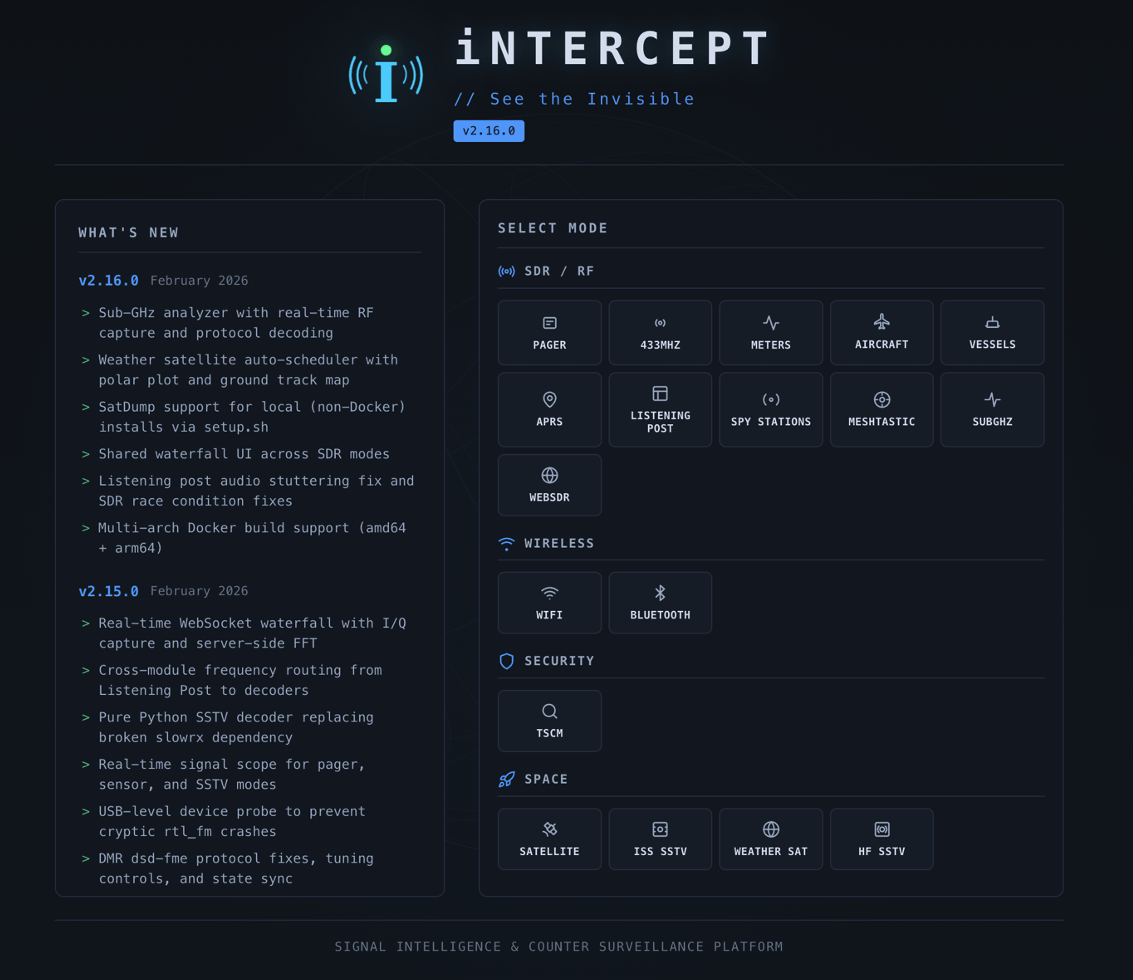
iNTERCEPT is an open-source tool for signal intelligence, which combines multiple SDR and RF toolsets into one web-based interface. This means you don’t have to switch between multiple interfaces; everything you need is in one place.
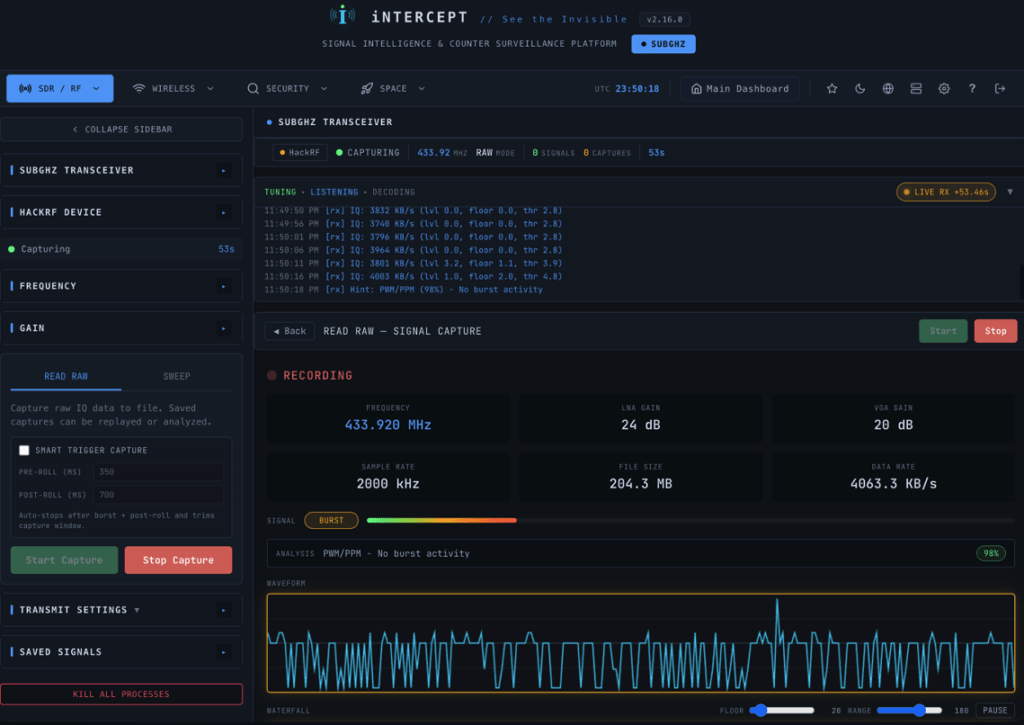
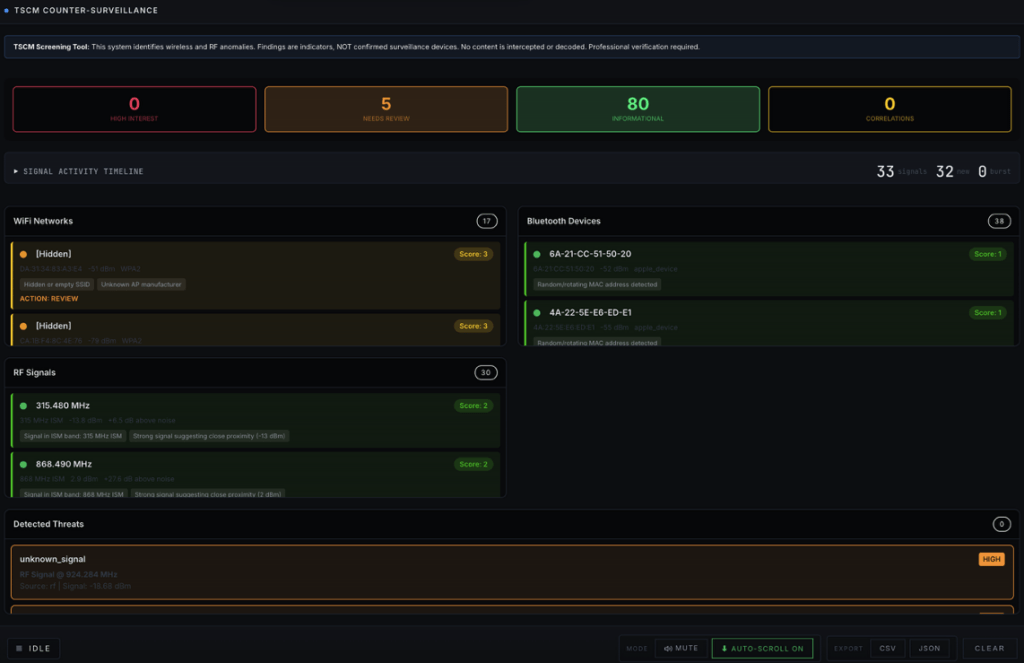
iNTERCEPT works with popular SDR hardware like RTL-SDR and other SoapySDR-compatible devices, and it combines features like aircraft tracking, vessel tracking, pager decoding, WiFi scanning, Bluetooth scanning, satellite tracking, and other TSCM-related toolsets into one interface.
If you’re an amateur, it makes it easier to work with. If you’re a TSCM practitioner doing legitimate work, some of the toolsets are designed with you in mind. It’s a wide-reaching tool for a wide-reaching industry like RF work.
What it really does, though, isn’t just list features and functionality. It’s how it all works together. Everything is unified, consistent, and accessible through one interface. That was the idea from day one.
iNTERCEPT wasn’t the result of a carefully designed and developed long-term product strategy.
It began as a small experiment. I was just messing around with AI tooling, and the tool of choice at the time was Claude. So, I said, “I’ll just make something.” And then the first thing worked, and then another, and another, and so on. And then, at a certain point, I said, “Wait a minute, this isn’t just a toy anymore; this is actually useful.”
And then, of course, I got hooked.
And the more features I added, the more I said, “Not only would this be nice to have, but why isn’t this all-in-one place already?”
And, of course, I’ve needed a project to keep my brain ticking over.
RF has been a long-term interest of mine, and so iNTERCEPT was a chance for me to work on something technical, something practical, and something constantly changing.
It’s worth talking about AI properly, because iNTERCEPT is AI-assisted.
There’s a tendency in some circles to dismiss AI-built projects as somehow lesser. I don’t agree with that.
AI is a tool. That’s all it is.
It doesn’t replace understanding. It doesn’t remove the need to debug. It doesn’t magically solve integration problems. I’ve spent countless hours (sometimes entire days) implementing features, fixing edge cases, refactoring sections of the UI, and testing hardware compatibility. The hard work is still very real.
What AI does do is accelerate iteration. It helps explore ideas faster. It makes it easier to prototype and refine.
Used correctly, it’s incredibly powerful.
iNTERCEPT is proof that AI plus human curiosity and persistence can produce something solid and genuinely useful. It’s not about replacing developers. It’s about building faster and thinking bigger.
One of the most unexpected parts of this journey happened over Christmas.
A YouTube video featured iNTERCEPT, and things escalated quickly. What I thought would be a quiet holiday break turned into responding to GitHub issues, feature requests and community messages.
The repository hit 1,100 stars. A Discord community formed and grew into the hundreds. Contributors began suggesting improvements and new modules. People I’d never met were using something that started as a small test project on my machine.
I genuinely didn’t expect that.
What started as a personal experiment had turned into something people found valuable. That was both exciting and slightly overwhelming in the best possible way.
The RF and cybersecurity communities have given me a lot over the years. The open-source tools, research write-ups, shared knowledge, documentation, and forum posts. So many resources that were contributed by people who did not have to share their knowledge.
The decision to open-source iNTERCEPT was purposeful. It’s a way to give back to that community.
If a new user to SDRs installs iNTERCEPT and finds that the learning curve is a little less intimidating, that is a win.
If a TSCM professional utilises a piece of iNTERCEPT during a legitimate TSCM engagement and finds that it makes their job a little bit easier, that is a win.
If other developers continue to make iNTERCEPT better than I could have made it alone, that is probably the biggest win.
iNTERCEPT is still evolving. The UI continues to be refined. Modules expand. Hardware support improves. Community ideas shape its direction.
It’s no longer just “my project.” It’s a community-driven platform that continues to grow because people see value in it.
And for me personally, it remains exactly what it was at the beginning. Something that keeps my brain engaged, challenges me technically, and scratches that long-standing RF itch.
Sometimes the best things don’t start with a business plan. They start with curiosity and grow because you can’t stop building.
iNTERCEPT just happened to take on a life of its own.
If you’re interested in exploring it, contributing, or joining the community, you can find it here: https://intercept-sigint.com
And if you’re into RF, SDR or SIGINT in any capacity, I suspect you’ll understand exactly why I built it.
’73’ Smittix